Educational Series: The Psychology Behind Home Staging | Set The Stage Northwest Arkansas
Have you ever toured an empty home that looked spacious in the listing photos, only to walk inside and think, “This feels much smaller than I expected”?
You’re not alone.
In fact, what you’re experiencing is a well-documented aspect of human perception. Our brains rely on familiar objects—such as sofas, dining tables, beds, and lighting—to judge size, distance, and function. When those visual reference points disappear, even a generously sized home can feel smaller, colder, and surprisingly difficult to understand.
This is one of the biggest reasons professional home staging is so effective. It’s not simply about making a property look beautiful—it’s about helping buyers accurately perceive the space and imagine themselves living there. According to the 2025 National Association of REALTORS® Profile of Home Staging, 83% of buyers’ agents said staging makes it easier for buyers to visualize a property as their future home.
Whether you’re preparing to sell in Bentonville, Rogers, Fayetteville, or anywhere else in Northwest Arkansas, understanding why empty homes feel different can help you make smarter decisions before your property ever reaches the market.
The Big Question
Why do empty homes feel smaller?
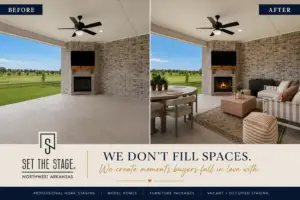
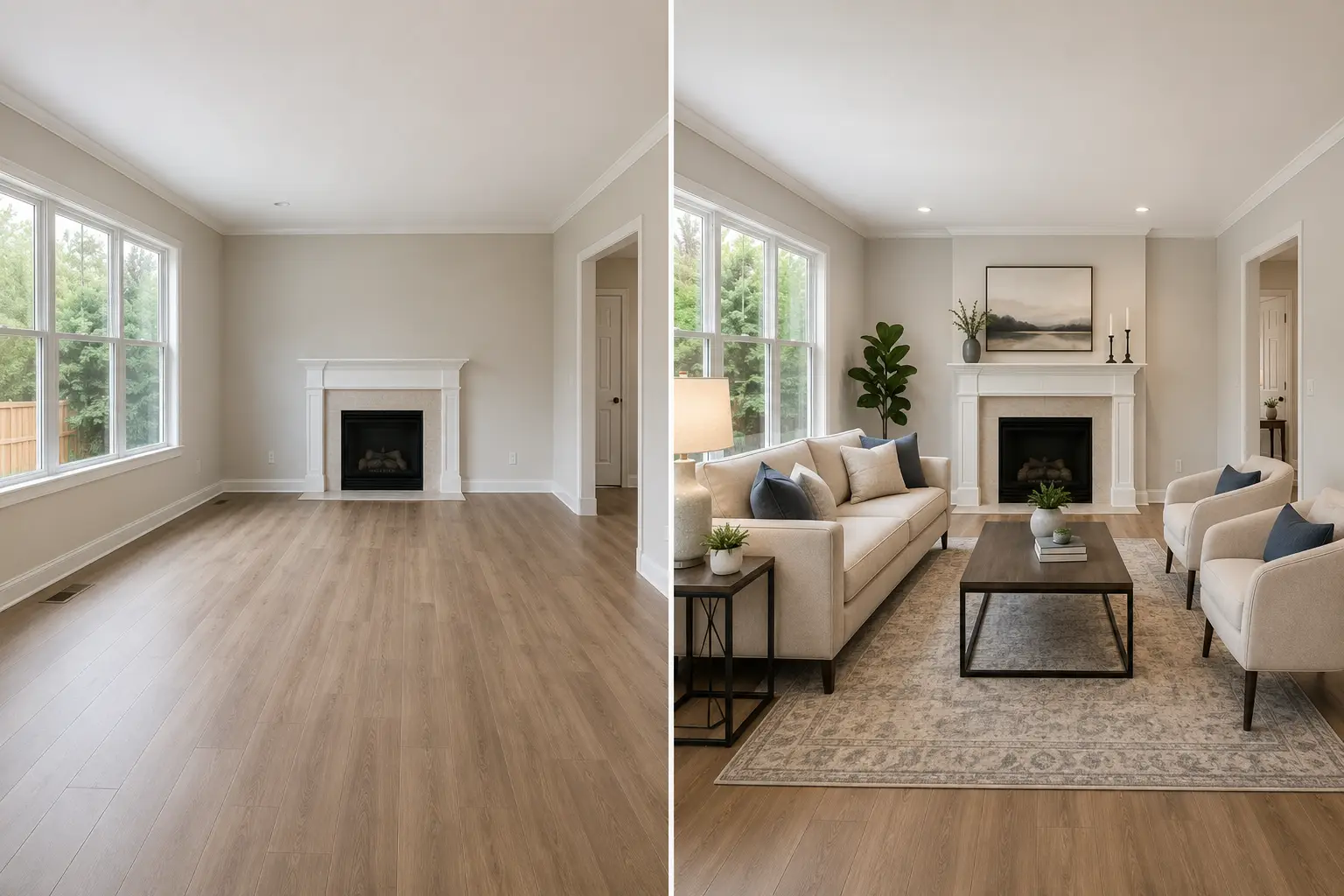
Empty homes often feel smaller because our brains depend on furniture and familiar objects to judge scale, proportion, and purpose. Without those visual cues, rooms can appear less functional, less inviting, and even physically smaller—even though the square footage hasn’t changed.
That’s not imagination.
It’s psychology.
Why Your Brain Needs Furniture to Measure Space
Imagine standing in an empty room.
Without a sofa…
Without a dining table…
Without a bed…
What tells you how large the room really is?
Almost nothing.
Your brain constantly compares objects it recognizes to estimate distance and size. This process happens automatically, without conscious thought.
A standard three-seat sofa instantly tells your brain:
- how wide the room is
- how much walking space exists
- where conversation areas belong
- how furniture might fit
Remove that sofa, and your brain loses one of its primary measuring tools.
Instead of seeing possibilities, it sees uncertainty.
🧠 Buyer Psychology Insight
People don’t buy square footage.
They buy how the space makes them feel.
If buyers can’t immediately understand how a room functions, many subconsciously assume the room is too small—even when it’s larger than average.
Professional home staging removes that uncertainty.
The Science Behind It
This is where psychology meets real estate.
Researchers who study visual perception have long known that humans estimate size using reference objects.
Think about looking at a mountain.
Without trees…
Cars…
Or people…
It’s difficult to judge how enormous it really is.
The exact same principle applies inside a home.
Furniture acts as a visual measuring system.
A queen bed instantly communicates bedroom size.
A dining table explains how many people can comfortably gather.
An area rug defines conversation space.
A sofa establishes scale.
These familiar objects help the brain quickly answer questions buyers rarely realize they’re asking:
- Could my family live here?
- Would my furniture fit?
- Is there enough room to entertain?
- Can I picture everyday life in this home?
Professional home staging answers those questions before buyers ever ask them aloud.
Why Empty Rooms Create More Questions Than Answers
Most homeowners believe empty rooms allow buyers to “use their imagination.”
Ironically, the opposite is often true.
An unfurnished room forces buyers to mentally solve several problems simultaneously:
- Where would the television go?
- How large should the sofa be?
- Does a king bed fit?
- Can this become a home office?
- Is there enough circulation space?
That mental work creates what psychologists call cognitive load.
The harder buyers must work to understand a space, the less emotionally connected they become.
Instead of imagining life there, they’re trying to solve a puzzle.
Professional home staging removes that friction by providing immediate visual clarity.
💡 STS Pro Tip
When staging a vacant home, every piece of furniture should have a purpose.
The goal isn’t to fill rooms.
The goal is to demonstrate how the home lives.
Thoughtful furniture placement helps buyers understand scale, flow, and function while keeping rooms feeling open and inviting.
Empty Doesn’t Always Mean Spacious
One of the biggest myths in real estate is that removing all furniture automatically makes a room look larger.
Sometimes…
It has the opposite effect.
Large empty walls emphasize emptiness instead of openness.
Wide floor areas become difficult to interpret.
Corners feel disconnected.
Ceiling heights become harder to appreciate.
Rather than showcasing spaciousness, the room can begin to feel unfinished.
Professional home staging introduces balance.
It gives buyers enough visual information to understand the space without making it feel crowded.
The Living Room Is More Important Than Most Sellers Realize
Among buyers’ agents surveyed by the National Association of REALTORS®, the living room ranked as the most important room to stage, followed closely by the primary bedroom and kitchen.
That makes sense.
The living room often creates the emotional center of the home.
It’s where buyers picture:
- relaxing after work
- hosting holidays
- watching movies
- spending time with family
- welcoming friends
When that emotional anchor is missing, buyers frequently struggle to connect with the property.
Northwest Arkansas Insight
Across Northwest Arkansas, many newly constructed homes and recently renovated properties enter the market completely vacant.
While clean, empty spaces may seem move-in ready, buyers touring homes in Bella Vista, Springdale, or Siloam Springs often face the same challenge: understanding how each room should function.
Professional vacant home staging bridges that gap by transforming open rooms into spaces buyers can immediately relate to, creating stronger first impressions from the moment they walk through the door.
If you’re preparing to list a vacant property, learn more about Professional Home Staging in Northwest Arkansas (https://nwa.wesetthestage.com/home-staging-in-northwest-arkansas-vacant-occupied-model-homes-and-turnkey-packages/).
Why Listing Photos Can Make an Empty Home Feel Even Smaller
Today’s homebuyers almost always form their first impression online. Before they schedule a showing, they’re scrolling through listing photos, comparing homes side by side, and deciding which properties are worth visiting.
An empty home has only seconds to make an impression.
Without furniture to establish scale, wide-angle photography can unintentionally work against the home. Buyers may struggle to understand room dimensions, identify focal points, or picture how everyday life would unfold within the space.
A professionally staged home, on the other hand, provides context in every image. A thoughtfully placed sofa shows the width of the living room. A dining table illustrates how many people the space comfortably accommodates. A well-proportioned bed demonstrates that the primary bedroom can support everyday living without feeling cramped.
Instead of asking buyers to imagine possibilities, staging presents them clearly.
🧠 Buyer Psychology Insight
People naturally compare homes while browsing online.
When one listing feels warm, functional, and inviting, and another appears empty and difficult to interpret, buyers often assume the staged home offers greater value—even if the two properties are nearly identical in size.
The difference isn’t always the home itself. It’s how easily buyers can understand it.
Professional Home Staging Builds Buyer Confidence
Buying a home is both a financial and emotional decision. While buyers evaluate square footage, location, and condition, they also ask themselves a much simpler question:
“Can I see myself living here?”
Professional home staging answers that question almost instantly.
Rather than decorating for decoration’s sake, a professional home stager creates visual cues that communicate how each room functions. Living spaces feel comfortable, bedrooms feel restful, and dining areas suggest gathering with friends and family.
That confidence matters because buyers who immediately understand a home’s layout are less likely to become distracted by uncertainty.
Instead of focusing on what might fit, they begin imagining what life could look like.
For homeowners preparing to sell, that’s one of the most valuable advantages of professional home staging.
If you’d like to learn more about our approach, explore our Professional Home Staging Services (https://nwa.wesetthestage.com/staging/).
Myth vs. Reality
Myth: Empty homes always look bigger.
Reality: Empty homes often feel smaller because buyers lose the visual reference points their brains use to judge scale and proportion.
Myth: Buyers can imagine where their furniture will go.
Reality: Most buyers find it easier to evaluate a home when rooms already demonstrate purpose and function. In fact, 83% of buyers’ agents say staging helps buyers visualize the property as their future home.
Myth: Home staging is only for luxury homes.
Reality: Buyers at every price point respond to spaces that feel welcoming, functional, and easy to understand. The psychology behind first impressions applies regardless of the home’s value.
📍 Northwest Arkansas Perspective
Northwest Arkansas continues to attract professionals, families, and corporate relocations drawn by the region’s growing economy and exceptional quality of life. Many buyers relocating from outside the area are unfamiliar with local floor plans and architectural styles.
In communities such as Bentonville, Rogers, Fayetteville, and Springdale, professionally staged homes help those buyers quickly understand how a property fits their lifestyle. Rather than asking them to interpret an empty floor plan, staging provides an immediate sense of comfort and possibility.
For sellers, that can make every showing more impactful.
💡 STS Pro Tip
Before listing a vacant home, walk through each room and ask yourself:
“If I had never seen this house before, would I immediately know how this space is meant to be used?”
If the answer is no, there’s an opportunity for professional staging to improve clarity and strengthen the buyer’s experience.
Quick Takeaways
- Empty homes often feel smaller because the brain relies on familiar objects to judge size and distance.
- Furniture provides visual scale, helping buyers understand how each room functions.
- Professional home staging reduces uncertainty and encourages emotional connection.
- Strong first impressions begin online, where staged listing photos provide context and purpose.
- Buyers are more likely to picture themselves living in a home that feels complete and inviting.
- Professional home staging helps showcase a home’s true potential without changing its square footage.
Frequently Asked Questions
Why do empty homes seem smaller than furnished homes?
Empty homes often appear smaller because the brain uses furniture and everyday objects as visual reference points to estimate size and distance. Without those cues, rooms can feel less defined, making it harder for buyers to appreciate the home’s true dimensions.
Does professional home staging actually help buyers visualize a home?
Yes. According to the 2025 National Association of REALTORS® Profile of Home Staging, 83% of buyers’ agents reported that staging makes it easier for buyers to visualize a property as their future home.
Is vacant home staging worth considering before listing?
Vacant home staging helps demonstrate room purpose, establish scale, and create stronger first impressions. Rather than asking buyers to imagine how the space could work, staging provides a clear, welcoming vision from the moment they enter.
Which rooms should be staged first?
The living room, primary bedroom, and kitchen typically have the greatest influence on buyers because they are the spaces where people most easily imagine everyday life.
Can staging help smaller homes feel more spacious?
Yes. Thoughtful furniture selection and layout help define traffic flow, establish proportion, and highlight usable space, often making rooms feel more open and functional than they do when left empty.
Looking Ahead in Our Educational Series
This article is the first in our Psychology Behind Home Staging series. Next, we’ll explore Why Buyers Decide Within Seconds of Walking Through the Front Door, uncovering how first impressions shape buying decisions before a single room has been fully explored.
Contact Us
If you’re preparing to sell a vacant or occupied home, book a professional home staging consultation in NWA. Our team helps homeowners, real estate professionals, builders, and investors present properties in ways that create stronger first impressions and help buyers see every home’s full potential.
Contact Us: https://nwa.wesetthestage.com/contact-us/